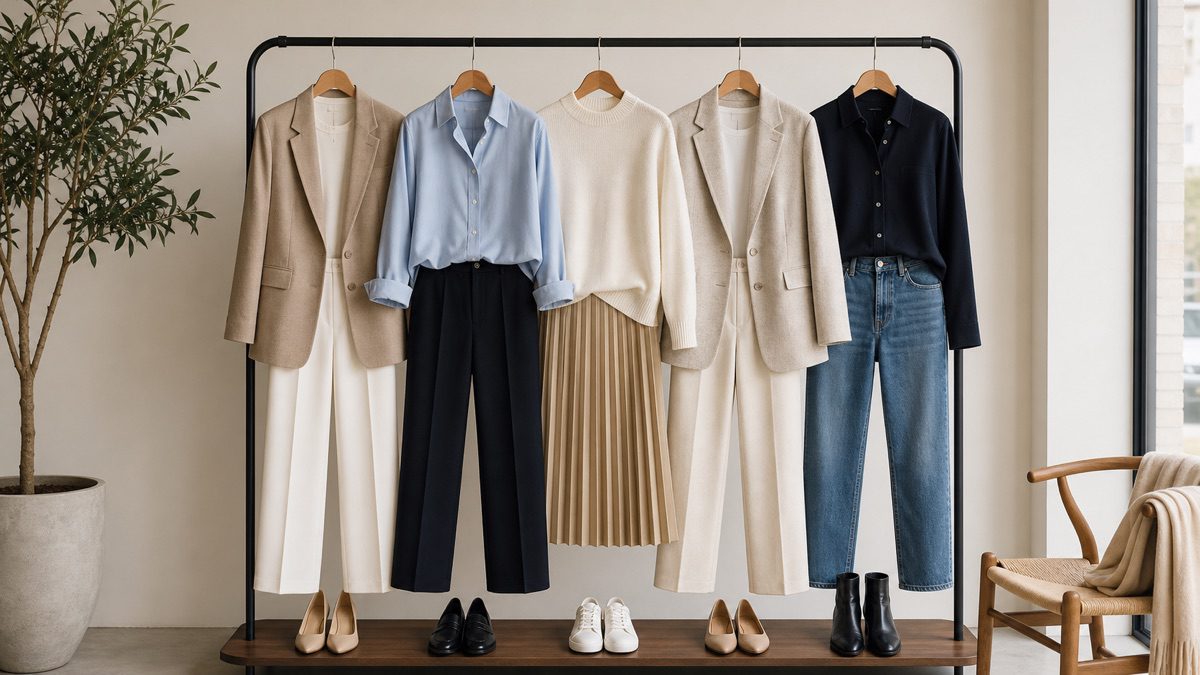
Use five flexible outfit formulas to create repeatable everyday looks without buying a completely new wardrobe.
Straight jeans, soft shirt, structured layer
This formula balances relaxed and polished elements. Use a button-down, fluid blouse, or fine knit as the soft piece, then add a blazer, chore jacket, or short coat. Keep shoe choice connected to the setting: loafers for polish, boots for weather, or clean sneakers for walking.
Wide trousers, compact top, simple shoe
A closer-fitting or neatly tucked top creates definition beside a wider leg. The top does not need to be tight; it only needs less visual volume. A belt, cropped layer, or partial tuck can establish the same proportion. Repeat the trouser color in the shoe for a longer visual line.
Column base, contrasting outer layer
Wear similar tones on top and bottom, then add a jacket or cardigan in a different color or texture. The column can be black, navy, cream, denim, or another repeated neutral. This formula is easy to adapt across seasons by changing fabric weight rather than the overall idea.
Dress, practical layer, grounded shoe
A dress becomes easier to wear when the supporting pieces match the activity. Add a cardigan or overshirt for temperature changes and choose a shoe you can actually walk in. A belt is optional; proportion can also come from sleeve length, jacket length, or a visible neckline.
Knit, skirt, deliberate contrast
Pair a soft knit with a skirt that contrasts in movement or texture: ribbed knit with satin, smooth merino with denim, or a relaxed cardigan with a structured A-line shape. Repeat one color in an accessory to make the combination feel intentional without over-coordinating.
Frequently asked questions
Do outfit formulas make style boring?
No. They create a stable structure while color, texture, accessories, and individual pieces provide variety.
How many formulas do I need?
Three to five formulas can cover most weekly routines.
Can one formula work year-round?
Yes, when you change fabric weight, footwear, and outer layers.
How do I find my best formulas?
Review outfits you repeated and identify their shared proportions.
Should accessories be part of a formula?
Include them when they solve a practical or proportional need.
Adjust formulas through proportion
The same garment list can create very different results depending on where hems, waistlines, and layers end. Photograph a formula with the top untucked, partially tucked, and fully tucked, then compare without judging in the mirror moment. Sleeve length and visible ankle or wrist can also change the balance. Keep the version that feels comfortable and works during movement.
Create a personal formula record
Save a simple note for successful combinations: base, layer, shoe, bag, and any weather adjustment. Include what made the outfit work, such as a shorter jacket over wide trousers or a low-contrast shoe with a midi hem. After several weeks, repeated patterns reveal which future purchases will integrate and which attractive items may require an entirely new formula.
Formula review checklist
- The outfit works while sitting and walking.
- Outerwear fits over the selected sleeves.
- Shoe height suits the hem.
- A weather variation is available.
- The formula uses mostly existing pieces.
Related ChicSeed guides
Continue with these practical guides from the same topic area:
